Sunday, May 9, 2010

Sometimes you just need to laugh...

Perhaps everyone at work is in a foul mood. And things are tense at home. To say nothing of the world news -- could it get any worse? At times like this, you need an escape. Have some chocolate and one of those decadent whipped latte frocha things. And settle in with a good read.

Here are two. One for middle grades. One for young adults.

THE POPULARITY PAPERS by Amy Ignatow (Amulet Books, $15.95, pub date April 1, 2010, ages 9 to 12).

Hilarious hijinks of two fifth grade girls who just want to be popular. They observe the popular girls in school to see what makes them tick. Is it their hair? Their cell phones? Their involvement in the school musical? Lydia and Julie record their findings in a journal. And that's what you're reading. It looks EXACTLY the way two fifth-grade girls would write and draw and doodle. If you're looking for something as laugh-out-loud funny as Jeff Kinney's Wimpy Kid books, but need something more girlish, this is for you. Amy Ignatow is a local Philly author/illustrator and I can't wait to see what she comes up with next.


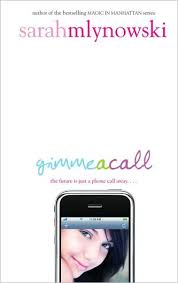
GIMME A CALL by Sarah Mlynowski (Delacorte Press, $17.99, Pub date April 27, 2010, ages 12 and up).

I don't remember the last time a book gave me such a serious case of the giggles. Gimme A Call is adorable. Of course, there's a serious side to it and the protag learns something (for all you aspiring authors out there -- this is an awesome example of character development). But, really, what a hoot!

Devi Banks is a 17-year-old high school senior. She's gotten into a crappy college, has lost all her friends, and just been dumped by her long-standing boyfriend. Then she drops her cell phone in a fountain. It won't work -- except to call herself at age 14. Once Devi the senior convinces Devi the freshman ("Frosh") she's for real, things get interesting. Frosh, we could get into a good college! We could get our friends back! And don't start going out with Brian. He'll break your heart!

That
kind of interesting.

Oh, just read it.

Monday, May 3, 2010

Things I wonder about at 3 am....

1) When the posted speed limit is 55, why does everyone drive 71 mph?

2) When you hang your towel back on the rack because the little card in the hotel bathroom cheerfully asks you to help save the environment, why does housekeeping change your towel anyway?

3) When the sign clearly states, "Please Do Not Play With Our Toys," why do so many parents allow their children to hug, suck, drool on, and drag the toys across the floor (without, of course, buying them)?

Can someone please explain this to me?

Signed,
Perplexed

Friday, April 30, 2010

Gem of the Week

Perhaps I should be calling these Gems of the Month, since I'm posting so rarely. Thanks to anyone who's still hanging in there reading this blog. I've turned into a haphazard blogger.

Recently I was involved in a discussion with other writers about world-building. As in, you're writing a science fiction or fantasy novel for kids or teens, and you need to create a world that's believable. How do you go about it?

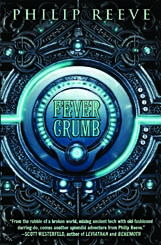
Philip Reeve is a master at world-building. Witness his Mortal Engines series. Now run to your local bookstore or library and take a look at Fever Crumb (Scholastic, $17.99, 9780545207195, for ages 12 and up, published April 1, 2010).


In this stunning prequel to the Mortal Engines series, a prequel that works just fine as a stand-alone novel, we meet Fever, an orphan in London. The London she lives in is thousands of years in the future, though it feels like the Dark Ages. Vestiges of technology remain -- odd bits of circuitry and microchips. But no one knows what to do with them. The Order of Engineers, a group of eccentric men who shave their heads and refuse to show emotions, try to make sense out of the old machinery. Fever has been raised by them, and mostly by Dr. Crumb, the man who found her when she was an infant.

But now everything's changing. An archeologist named Kit Solent hires Fever to be his assistant and it quickly becomes apparent that he's more interested in finding out what's going on in Fever's mind. She's beginning to have memories that are not hers. Who exactly is Fever Crumb? Who were her parents? Does she have anything to do with the Scriven, the superior humans driven out of London years ago?

Written with a sure hand, and a touch of cheeky humor (in the future, there's a krishna-like group wandering around London chanting, "Hari Hari, Hari Potter"), this is a fascinating example of masterful world-building. If you're a fan of Scott Westerfeld or Philip Pullman, this is right up your alley.

Monday, April 12, 2010

Top Children's Novels of all Time?

Over at School Library Journal, Betsy Bird blogs about books in Fuse#8 productions. According to her profile on SLJ, "Elizabeth Bird is currently a children's librarian at the Children's Center at 42nd Street of the New York Public Library system. She has served on Newbery, written for Horn Book, and has done other lovely little things that she'd love to tell you about but that she's sure you'd find more interesting to hear of in person. Her opinions are her own and do not reflect those of NYPL, SLJ, or any of the other acronyms you might be able to name." Her blog is one of my favorites.

Since February, she's been gradually revealing the results of a poll in which I happily participated, along with many other booksellers and librarians. That was a tremendous amount of work, and I want to thank her for her amazing efforts. Counting down from 100, she's just finished announcing #1 which was my pick for #1. Yay!).

Here are the top ten:

1. Charlotte's Web
2. A Wrinkle in Time
3. Harry Potter and the Philosopher's Stone (original title, of course)
4. The Lion, the Witch, and the Wardrobe
5. From the Mixed-Up Files of Mrs. Basil E. Frankweiler
6. Holes
7. The Giver
8. The Secret Garden
9. Anne of Green Gables
10. The Phantom Tollbooth


If you want to see a straightforward list of all 100 titles, click on over to Six Boxes of Books, where Wendy, Laurie and Kathleen have diligently added them as they've been announced (extremely helpful; thanks, Laurie).

If you want to read longer, more detailed descriptions of each book and why it was chosen, and see all of the various covers for each title over the years, go to Fuse #8. Her April 1st post almost gave us all heart attacks. Before she changed it to Secret Garden, she had listed... The Boy In The Striped Pajamas. AAGGHH!

Here were MY top ten:

1. CHARLOTTE'S WEB
2. THE PHANTOM TOLLBOOTH
3. HOLES
4. FROM THE MIXED-UP FILES OF MRS BASIL E. FRANKWEILER
5. THE SECRET GARDEN
6. THE DARK IS RISING
7. SARAH, PLAIN AND TALL
8. JAMES AND THE GIANT PEACH
9. HARRIET THE SPY
10. MANIAC MAGEE

I'd love to hear from readers. What would YOUR top ten kids' books be?

Monday, March 29, 2010

Sense of Place

I haven't been blogging much, because I've been hard at work on a middle grade novel. It takes place in an alternate universe, but with a rural setting. I've had to draw a map for myself so I can figure out where everything is. But what I keep picturing in my mind is my grandparents' house, which was built in 1926. More on this later.

Picturing a familiar place while trying to describe a made-up one made me think about what I picture when I read novels.

When you're reading a book for the first time -- let's use


The Hunger Games by Suzanne Collins as an example --


do you picture certain scenes taking place in locales that are familiar to you? Say, your childhood home? Your backyard?

Okay. Promise not to laugh.

When I first read The Hunger Games, I couldn't help picturing the fence around Katniss's district (the one she illegally crosses to go hunting) as the fence around my elementary school playground. And yes, there was a woods (albeit a tiny one) beyond that fence. So now when I re-read the book, I automatically picture Katniss hunting in that little woods beyond that same playground. I can't help it. And that sense of place carries over to the Arena -- which, you guessed it -- looks like the larger section of the playground in my mind. Hey, it was a big playground, and not just because I was small.

With other scenes or while reading other books, I'm usually able to conjure up a setting from my imagination. But occasionally, I find myself falling back on familiarity and picturing places I've actually known. I have no clue why I do this, but I do. Perhaps a psychologist could answer that. The comfort of familiar turf? A place where I felt safe?

Who knows.

Does it mean my imagination isn't strong enough to create every scene from scratch? Or does it simply mean that I had a nurturing childhood? When I read Charlotte's Web, I picture my grandparents' house -- even though it wasn't a farm. (*Also note that I didn't read Charlotte's Web until I was in my 20s, which was when I lost my grandparents -- ooh, deep psychological stuff here*). They had three acres so since I grew up in the suburbs on a third of an acre, maybe to my mind their property was as big as a farm. And that's probably why I keep picturing it while writing a novel that takes place on a farm.

Tell me about your favorite children's books. What scenes have you pictured taking place in familiar settings?

Sunday, March 14, 2010

Voice, not trends

Here's one quote that writers of children's books will want to read:

"As for fiction, we're open to anything for middle-grade readers and teens, although we're always more interested in voice than trends."

Laura Godwin, v-p and publisher, Henry Holt Books for Young Readers


It's nice to know there's at least one publisher out there who isn't looking for the latest trend. Here's the link so you can read the entire article. Michelle Kemper Brownlow posted some different (and equally helpful) quotes from the same article here.

Friday, March 5, 2010

In the words of agent John Cusick, "Write first, tweet later" OR: I'm ba-aack... but not for long

Hey all. I'm back. Having accepted Laurie Halse Anderson's "Double-dog dare," I stayed away from this blog (and unfortunately all of yours, too -- ulp, sorry). I stayed away from Facebook and Twitter... and television (well, except for some of the Olympics). And I wrote.

And wrote.

I'm happy to say that the middle grade novel I was stuck on six months ago (I stalled out at 4983 words), now has seven chapters and 11,149 words! Woo hoo! And I'm finally starting to imagine where it's heading (I've never been big on outlining).

So there is something to be said for writing first and tweeting later. Where did that great quote come from? Cynthia Leitich Smith author of Eternal and Tantalize, among other titles) has a wonderful blog called CYNSATIONS. On March 2, she posted an interview with John Cusick, an agent (and soon to-be-published young adult author) who works at Scott Treimel NY. The interview itself is interesting reading, especially for aspiring writers. But the best part for me is the paragraph in which the interviewer, Jenny Desmond Walters, asks John if an online presence is important for writers. And he says for authors of teen books, yes. Published authors. But before you rush off to develop your web presence, read on. He then says:

"However, as an unpublished author seeking representation, your time is best spent developing your craft. Write first, tweet later."

Exactly what Laurie Halse Anderson was talking about. So I may pop in from time to time with a book review, but I won't be on here very much.


And I'll leave you with a few Gems of the Week (or Month?), because, of course, I've also been reading. I can't NOT read. That would be like, well, not breathing.


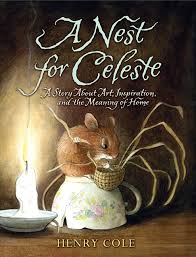
A NEST FOR CELESTE A Story about Art, Inspiration and the Meaning of Home, written and illustrated by by Henry Cole (Katherine Tegen Books/HarperCollins, $16.99, March 2010, ages 8 to 12)

Adorable. I would have cherished this book when I was 8 years old. It's about a mouse in search of a safe home, the friends she meets, and in particular, a boy named Joseph who happens to be the assistant to the naturalist John James Audubon. You'll learn something about Audubon, and about New Orleans in 1821. Mostly you'll be charmed by this engaging tale, though it's not without its frightening moments (some grisly hunting scenes). With lots of lovely pencil drawings. This reminded me of The Rescuers by Margery Sharp, with illustrations by Garth Williams, or even The Mouse and the Motorcycle by Beverly Cleary.

COMING SOON TO A BOOKSTORE NEAR YOU:


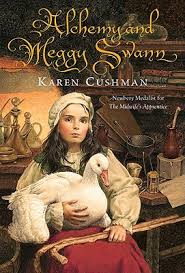
ALCHEMY AND MEGGY SWANN by Karen Cushman (Clarion Books, $16.00, April 2010, ages 10 to 14).

Meggy Swann has just arrived in London, having been sent away from her village by her mother. The father she never knew, an Alchemist, had asked for her. But after taking one look at her, with her sticks for walking, he ignores her, and Meggy is left to fend for herself. She has only her goose friend, Louise, for company. But Meggy is stubborn and smart and soon finds a way to make herself useful.

Set in 1573 (Elizabethan England, but before the time of Shakespeare), this is the newest novel by the author of Catherine, Called Birdy and The Midwife's Apprentice. The advanced reader's copy says the book is for ages 10 to 14, but I'd judge it fine for 8 to 12.


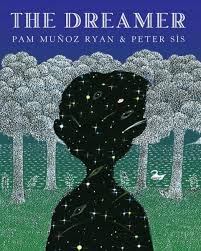
THE DREAMER written by Pam Munoz Ryan and illustrated by Peter Sis (Scholastic, $17.99, April 2010, ages 9 to 14).

Stunning, poetic, and extremely thought-provoking. This beautiful dream of a novel is loosely based on the childhood of Chile's most famous poet, Pablo Neruda. It's the story of Neftali Reyes, a thin, sickly child who grows up collecting things: seashells, birds' nests, keys, words. Neftali wants to write, but his strict and demanding father wants him to study law or medicine.

Includes an author's note, some information about Pablo Neruda and a sampling of his poetry, as well as numerous illustrations by the Caldecott-winning artist Peter Sis. (Final art not in advanced reader's copy).

This book will win all kinds of awards. You heard it here first.